That three o’clock stretch used to have a natural shape to it. The afternoon nap gave the day a pause: a breath in, a breath out. When your toddler woke, they were reset, soft-eyed and ready for the gentle slide toward dinner and bedtime. Then, somewhere between two and five, often around three or four, that pause disappears. The nap drops. Suddenly the longest, most demanding stretch of the day has no built-in relief.
If you have found yourself reaching for a screen just to get through that gap, to survive the witching hour before dinner or to have five minutes of peace, you are not alone and you are not failing. But there is a better rhythm available to you, and it is one early childhood educators have relied on for years. It is called quiet time. When it is introduced well, it becomes the exhale your child has been waiting for all day.
This article will walk you through exactly how to build a screen-free afternoon quiet time routine for your toddler or preschooler. It is realistic, grounded in how young children actually develop, and restorative for both of you.
Why the Nap Drop Is Harder Than It Looks
The afternoon nap does not just give parents a break. For toddlers, it is when the brain files away the morning and restores the capacity to cope with the afternoon. When that nap goes, children do not suddenly stop needing rest. They simply stop being able to get it through sleep.
What replaces the nap is a need for low-stimulation downtime. The child is not tired enough to sleep, but they are depleted enough to struggle. The afternoon meltdowns, the clinginess and the inability to manage a sibling or a snack are not behaviour problems. They are what a worn-out two or three year old looks like at 3 pm.
Screens appear to solve this because they are instantly absorbing. But holding a child’s attention is not the same as resting them. Australia’s 24-hour movement guidelines recommend no screen time for children under two and less than an hour a day for children aged two to five, and many parents notice the afternoon gets harder, not easier, once the screen goes off.
Quiet time, built around low-stimulation, hands-on, self-directed play, meets the actual need. It is not a distraction strategy. It is a rest strategy.
What Quiet Time Actually Means (And What It Does Not)
Quiet time is not a nap replacement in the literal sense. You are not trying to get your child to sleep. You are creating a bounded period, typically 30 to 60 minutes once it is established, in which the space, the materials and the expectations all send one message to your child: you can slow down now.
It is also not free play in the usual sense. Free play in the morning, when a child is rested and settled, looks very different from free play at three in the afternoon when they are running on empty. Giving an overtired toddler unlimited space and options is a reliable path to overwhelm. Quiet time is deliberately contained: one space, a small number of chosen materials, and a predictable beginning and end.
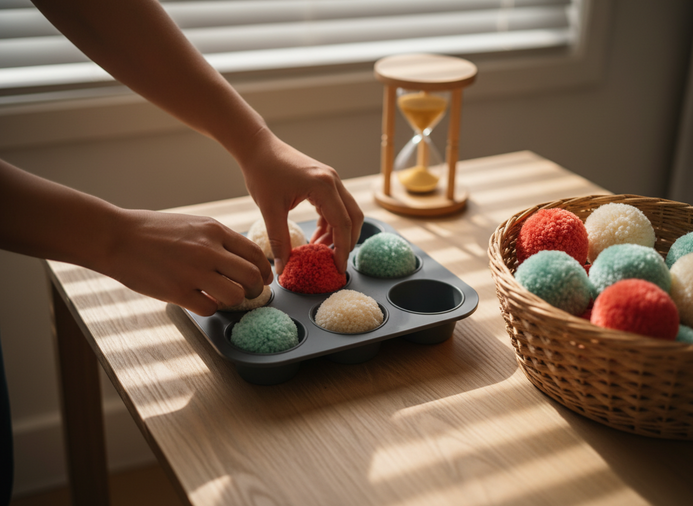
The calm preparation of a quiet-time invitation , setting up the environment is the first step in the ritual.
And it is not screen-free as a point of principle. It is screen-free because the goal is for your child to settle, and a screen keeps a tired brain busy rather than letting it rest. The whole point is to give your child a different kind of input: slower, more predictable, self-paced and hands-on.
Scaffolding the New Rhythm at Home
The first two weeks are the hardest. The parents who succeed treat quiet time as a skill to be taught, not a rule to be enforced. Your child does not already know how to do this. They need to learn it, and they need your help while they do.
Start with the space. Before you introduce quiet time to your child, set up the space. Choose a consistent location: their bedroom, a corner of the living room, a low-light reading nook. The location matters because the space itself will become a cue. When your child enters it at that time of day, they will begin to shift gears, in the same way a bedroom comes to mean sleep.
Lower the lights and the volume. Dim the lights or close the blinds partially. Put on quiet instrumental music at low volume: nature sounds, classical guitar, soft ambient music. These are not decorative choices. They tell your child the pace in this room has just dropped.
Start small. If you begin with a 45-minute expectation on day one, you will fail. Begin with ten minutes. Sit nearby for the first few sessions. Your calm presence does a lot of the settling for them. Extend the duration gradually over two to three weeks as their capacity grows.
Use a visual timer. Toddlers and preschoolers cannot picture abstract time. A sand timer or a visual time-wheel gives them something concrete to watch. It also takes you out of the role of enforcer: the timer ends quiet time, not you, which dramatically reduces resistance.
Rotate the materials. The same tray every day will stop working within a week. A small rotation of three or four options over a two-week cycle keeps things fresh without overwhelming. The mild surprise of seeing today’s invitation is itself part of what draws a child in.
Screen-Free Invitations for the Younger Toddler (2 to 3 Years)
Younger toddlers need materials that are hands-on, open-ended and need no explanation. The invitation should be immediately accessible. A child who has to ask how to use something is already working too hard for a rest period. At this age, stay within sight: small items like rice, lentils, pom-poms and buttons still end up in mouths, so quiet time means you are nearby, not in another room. Here are the invitations that work most reliably.
Shallow water play. Fill a baking dish with an inch of warm water. Add a drop of dish soap for bubbles, a sponge, and two or three sturdy plastic or rubber animals. Place it on a folded towel on the kitchen or laundry floor. Warm water is one of the most reliably calming experiences for a toddler, and the contained setup keeps it manageable for parents.
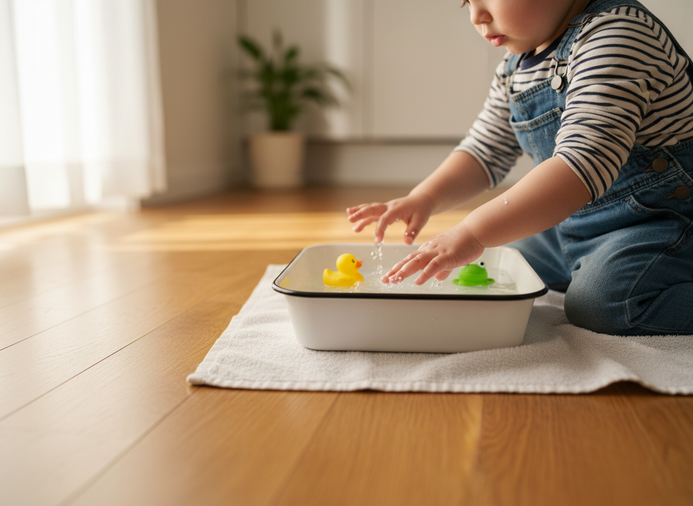
Shallow water play in a contained baking dish , one of the most reliably regulating sensory invitations for younger toddlers.
Dry sensory bins. A deep container of dried rice, lentils or oats with a set of spoons, small cups and a funnel offers the same settling effect as water play with far less mess. The rhythmic scooping and pouring keeps itself going. Toddlers will often continue for 20 to 30 minutes without any adult input.
Simple posting and sorting. A muffin tin and a pile of large pom-poms in three colours. A cardboard box with a slot in the lid and a handful of large craft sticks. A set of nesting cups. These are low-stimulation, repetitive and deeply satisfying to a toddler who is right in the middle of learning to sort and order the world.
Playdough with natural additions. A ball of homemade playdough, which is softer and more pleasant to handle than the commercial kind, alongside a small tray of pressed flowers, short twigs and smooth pebbles for pressing. A pinch of dried lavender or a drop of vanilla essence in the dough adds a gentle scent.
Board books in a cosy nook. For the child who is close to sleep, a small pile of familiar board books in a dim, cushioned corner is often all that is needed. Do not underestimate a well-loved, familiar book for a tired toddler. The predictability is the point.
Screen-Free Invitations for the Preschooler (3 to 5 Years)
Preschoolers can sustain longer quiet time and handle more complex open-ended materials, but they are also more likely to push back if it is introduced as a rule rather than a ritual. The framing matters: this is their special time, in their special space, with materials chosen just for them.
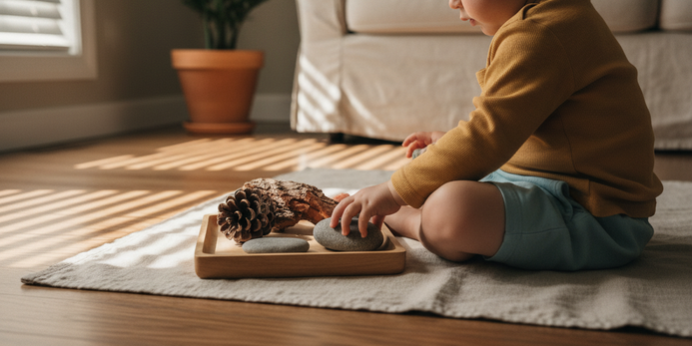
Loose parts invitation trays. A shallow wooden tray holding a curated collection of safe household materials: large buttons in varied shapes, wooden pegs, fabric scraps in earthy textures, smooth river stones, dried botanical sprigs, presented neatly on a linen mat. This is the preschool equivalent of a blank canvas. The child becomes the designer, the arranger, the architect. There is no wrong way to use it, which removes any pressure to perform and allows real absorption.
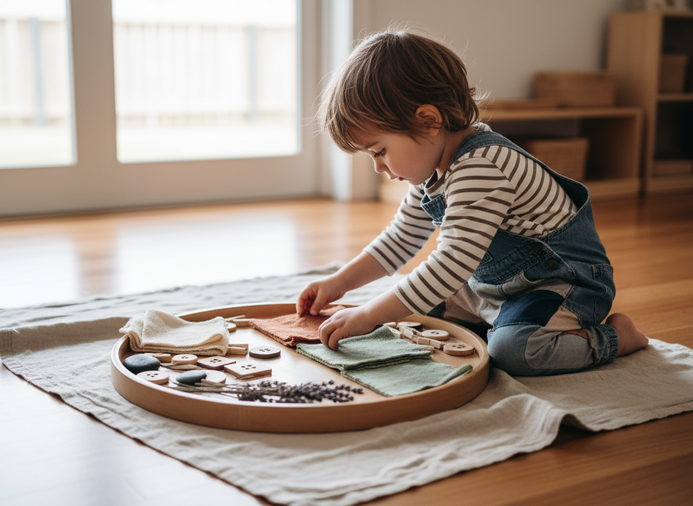
A preschooler deeply absorbed in a loose-parts invitation tray , demonstrating that children, given the right materials, can sustain self-directed, screen-free play.
Small world play. A tray of sand or kinetic sand with a collection of small figurines, rocks and twigs creates a whole contained world a preschooler can inhabit for a long stretch. Unlike a screen, the child is the author of the story rather than the audience.
Drawing and mark-making. A set of good-quality coloured pencils, not the waxy low-pigment kind, with a small stack of cartridge paper or a blank notebook. Add a loose theme if you like: a feather, a pressed leaf or a photograph of a bird placed beside them. The object is the invitation; what the child does with it is entirely their own.
Threading and weaving. Large wooden or plastic threading beads with chunky laces, or a simple weaving frame made from a notched cardboard rectangle and strips of fabric, builds the fine motor skills preschoolers are actively chasing while the slow, repetitive motion helps them settle.
Audiobooks and picture books. A calm, narrated audiobook rather than a dramatised production with sound effects, played at low volume while the child lies on a rest mat with a blanket, is one of the most powerful quiet-time tools for preschoolers. It keeps the imagination busy while the body rests.
When Your Child Resists (And They Will)
Resistance in the first week is not a sign that quiet time is failing. It is a sign the skill is being learned. A child who has never been asked to settle themselves without a screen or a parent’s direct entertainment is building a new capacity. That takes time, repetition, and your warm, confident persistence.
The most common resistance patterns and what they mean:
“I’m not tired.” This is true, and it is not the point. Gently reframe: “Quiet time isn’t for sleeping. It’s your special time to play quietly in your space.” Taking sleep off the table removes the most common point of conflict.
Coming out repeatedly. Return your child to the space calmly, without a long discussion or negotiation. Each return is a repetition of the boundary, not a failure. Treat it as information: they may need you closer, the materials may need refreshing, or the duration may need shortening. Adjust accordingly.
Escalating to distress. If a child becomes truly distressed rather than frustrated or mildly resistant, sit with them in the space rather than abandoning quiet time altogether. The goal shifts from independent quiet time to quiet time with you alongside, and that is a completely valid step in the progression.
Falling asleep. This is fine. It means they needed it. Adjust your expectations for bedtime, but do not prevent the sleep. A body that finally finds rest during quiet time is a body that needed it.
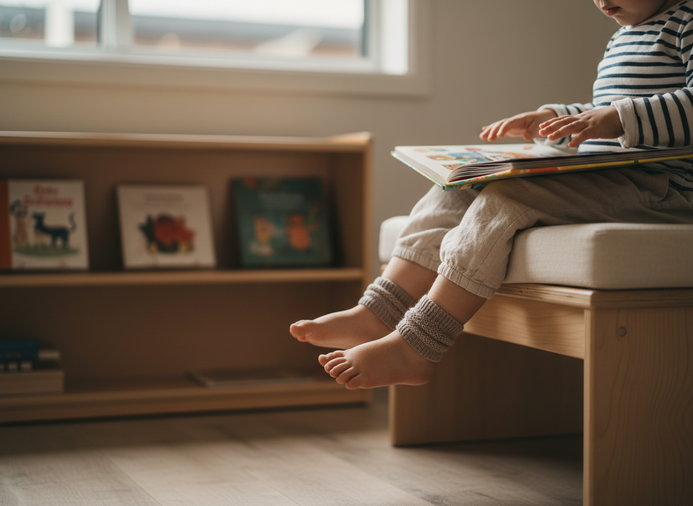
A toddler in a calm rest corner, the exact moment quiet time is designed to support.
Building the Rhythm: A Simple Starting Framework
If you are starting from scratch, here is the simplest version of a quiet time framework to begin with this week.
Same time every day. Predictability is what settles a child. Choose a time, typically between 1 pm and 3 pm, and protect it as consistently as you would a meal time or a bedtime.
Same space every day. The environment is the cue. Choose one location and use it only for quiet time.
One invitation, presented neatly. Set up one tray or one activity before you bring your child to the space. A prepared invitation tells them this was made for them, which shifts the tone from enforcement to gift.
A clear beginning and end. “Quiet time starts when the sand timer is turned over, and it ends when all the sand has moved to the bottom.” Concrete, predictable, and enforced by an object rather than a parent.
A calm transition out. When quiet time ends, do not jump straight into a high-energy activity. A snack, a walk outside or a shared book keeps the settled mood going a little longer. The transition out is as important as the transition in.
You do not need to get this perfect. You need to begin. The rhythm will build itself, week by week, repetition by repetition, until the three o’clock stretch stops feeling like the hardest part of the day and starts feeling like something you and your child both know how to do.
That is what a good rhythm does. It turns the hard thing into the familiar thing. And familiar, for a toddler, is the closest thing there is to safe.
How This Connects to What Educators Do Every Day
At Okinja Early Learning Centre on the Sunshine Coast, the rhythm of the day is never accidental. Our play-based, Reggio-inspired program is built on the same principle you are using at home: the environment itself is the invitation. Our Educators set out open-ended natural materials, read the energy of the room, and adjust the pace to meet children where they are rather than where a timetable says they should be.

Experience the Okinja difference. We invite you to book a tour of our unique indoor-outdoor learning environments.
The early afternoon rest and transition period is one of the most carefully considered parts of our day. Lights are dimmed, music is chosen deliberately, and rest mats go out with the same predictable ritual every time. Children who are not sleeping settle into quiet, individual invitations in a low-stimulation space. This sits within the Early Years Learning Framework’s focus on being, belonging and becoming: a child who feels secure in a familiar rhythm is a child who is free to play, explore and learn at their own pace.
When families repeat even a simplified version of this rhythm at home, the effects compound. Children who experience consistent, predictable downtime, at home and at their early learning centre, become children who can tolerate a little boredom, start their own play, and do not need constant entertainment to feel okay. That capacity is the foundation of lifelong learning, and it is exactly what a play-based curriculum is designed to grow.
If you are navigating the nap drop and would like to see how rest, rhythm and play fit together in practice, you are welcome to book a tour of Okinja Early Learning Centre.