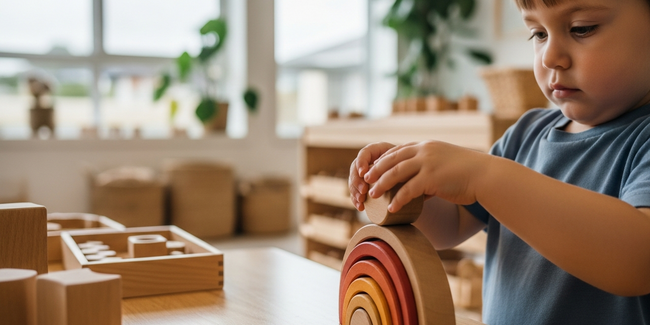
Watch a toddler with a set of wooden stacking toys and you’ll see it almost immediately. They place one, consider it, remove it, place it again. Then again. Then once more, just slightly differently. To a passing adult it might look like they’re going in circles — but look a little closer and you’ll notice something else entirely: intense concentration, deliberate adjustment, and the quiet satisfaction of a child who is absolutely absorbed in what they’re doing. If this scene is familiar, you’re not alone.
It’s tempting to redirect this kind of behaviour, to introduce something new or wonder whether your child is stuck. But what looks like repetition for its own sake is actually something far more purposeful. Young children repeat because they are learning — deeply, methodically, and on their own timetable. That toddler stacking and restacking isn’t going in circles; they’re building their brain.
Early childhood researchers describe this as schema play: repeated patterns of behaviour through which toddlers explore and make sense of the world around them. It’s a concept embedded in Australia’s Early Years Learning Framework (EYLF), which recognises children as capable, curious learners who actively drive their own development. Far from being a sign of limited imagination or a habit to break, repetitive play is one of the most reliable signs that a child is actively constructing their understanding of how things work. Once you know what to look for, you’ll start to see the learning in every ‘again!’
The Neuroscience Behind Repetitive Play
When toddlers engage in repetitive behaviors, they’re literally building their brains. Each repetition strengthens synaptic connections, creating more efficient neural pathways through a process called myelination. Think of it as upgrading from a dirt road to a superhighway – the more frequently a pathway is used, the faster and more reliable information travels.
There’s a genuine biological reason why toddlers repeat things so enthusiastically — and it has everything to do with how the brain builds itself.
Myelination: building faster, stronger pathways
Every time a child practises a skill or action, the neural pathway associated with it is reinforced through a process called myelination — the gradual coating of nerve fibres with a protective sheath that makes signals travel faster and more efficiently. Think of it as upgrading a dirt track to a sealed highway. The more a pathway is used, the more reliable it becomes. Repetition isn’t just rehearsal; it’s the mechanism the brain uses to make a skill permanent.
How repetition moves learning into long-term memory
Toddler brains process information differently from adult brains. A single exposure to a new experience is rarely enough to consolidate it. Repetition gives the brain the multiple passes it needs to move new knowledge from working memory into long-term storage — where it becomes a stable foundation for more complex thinking.
The role of dopamine: why repetition feels good
When a toddler repeats something they enjoy, the brain’s reward system is activated, releasing dopamine — the same chemical associated with pleasure, motivation, and learning. This isn’t accidental. Nature has designed repetition to feel rewarding, so that children are intrinsically motivated to keep practising the skills their developing brains need most.
Why interrupting matters
When repetitive play is consistently redirected or cut short, children lose the opportunity to complete the neural consolidation they were working toward. The learning cycle gets interrupted before it can land. This is why early childhood educators are trained to observe and support repetitive play rather than automatically redirect it toward variety.
Types of Repetitive Play and What They Build
Repetitive play takes many forms, each tied to a different area of development. Here’s what to look for — and what’s actually happening beneath the surface.
Schema play: trajectory, enclosure, rotation, and transporting
Schema play refers to the repeated patterns of behaviour children use to explore key concepts. Early childhood researcher Chris Athey, building on Jean Piaget’s foundational theories of cognitive development, identified specific schemas that appear consistently across young children worldwide:
- Trajectory schema: A fascination with how things move through space — dropping objects, throwing balls, watching water flow. Through this, toddlers develop spatial awareness, cause-and-effect reasoning, and an early intuitive feel for physics. A parent might notice: their two-year-old drops a piece of toast, watches it land, then looks up — not for a reaction, but to see if it happens the same way again.
- Enclosure schema: An interest in putting things inside other things, building boundaries, or wrapping objects up. This builds mathematical understanding of inside/outside, full/empty, and spatial containment. You might see: a toddler who fills and empties the same container repeatedly, or lines blocks around a toy to create a ‘fence’ every single time they play.
- Rotation schema: A drive to spin, turn, and rotate — wheels, lids, their own body. This supports vestibular development, balance, coordination, and the foundations of mechanical understanding. A parent might observe: a child who insists on spinning the wheels of every toy car and gets frustrated when a wheel doesn’t move.
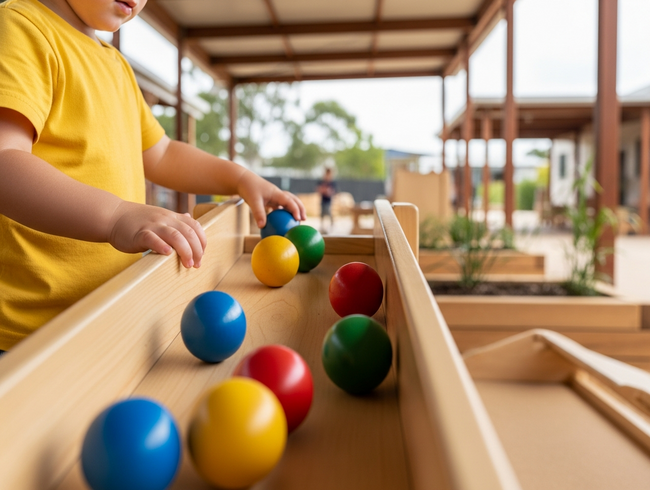
- Transporting schema: Moving objects from one place to another — filling bags, carrying handfuls of toys across the room, pushing things in prams. This builds strength, coordination, and an understanding of space, quantity, and distance.
Repeated book reading: language, narrative, and prediction
When a toddler demands the same book for the fifth time in a day, they’re not bored — they’re mastering it. Each reading builds vocabulary, narrative comprehension, and the ability to predict what comes next. Anticipating a familiar line (“I’ll huff and I’ll puff!”) is a genuine cognitive achievement — the child is using memory, sequencing, and language all at once. A parent might notice: their child starting to ‘read’ the book back to them, filling in repeated phrases from memory — this is language acquisition happening in real time.
Repeated physical play: muscle memory and gross motor confidence
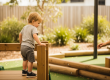
Going down the same slide, climbing the same structure, jumping off the same step repeatedly builds something important: motor confidence. Each repetition refines balance, coordination, and body awareness. The child isn’t doing it because they can’t think of anything else — they’re doing it because each attempt feels slightly different and teaches them something new about their own body. You might see: a child who insists on the same climbing frame every visit, and over weeks becomes noticeably more fluid, confident, and willing to try variations.
Repeated constructive play: spatial reasoning and trial-and-error
Building the same block tower, knocking it down, and rebuilding it is one of the richest early learning cycles there is. Each attempt involves planning, spatial reasoning, and problem-solving. The child is testing hypotheses: what happens if I place this block here? What if I make it taller? Knock-down-and-rebuild play is trial and error in its purest form, and the repetition is precisely how understanding develops. A parent might notice: that their child’s towers gradually become more stable over days or weeks — quiet evidence that learning is compounding with every attempt.
How to Support (Not Interrupt) Repetitive Play
Recognising when repetition is purposeful
Most toddler repetition is purposeful — it’s engaged, focused, and often accompanied by a look of concentration or satisfaction. The key question to ask is: does my child seem involved? If the answer is yes, the best thing to do is let the play continue. Purposeful repetition has a natural end point; children move on when they’re ready.
Language to use: narrating without redirecting
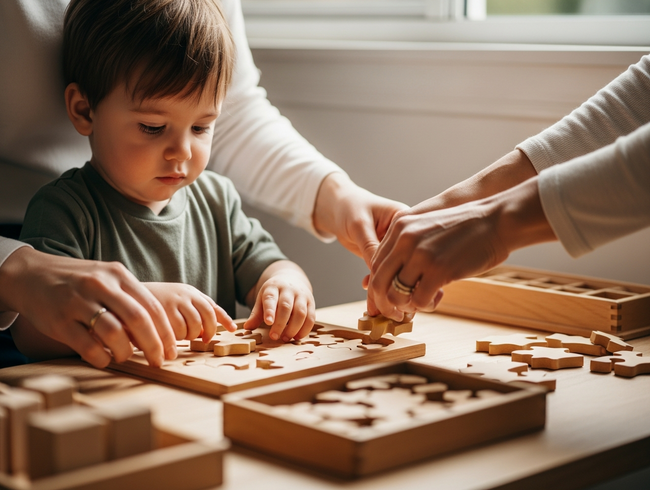
One of the most effective things a parent or carer can do is narrate what they see, without steering the play elsewhere. Simple observations add language and thinking to what’s already happening. Try: “You’re putting the block inside the box again — it fits!” or “Down it goes — the feather lands slowly, but the block drops fast.” This enriches the experience without interrupting the child’s learning flow.
Providing varied materials that support the same schema
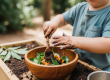
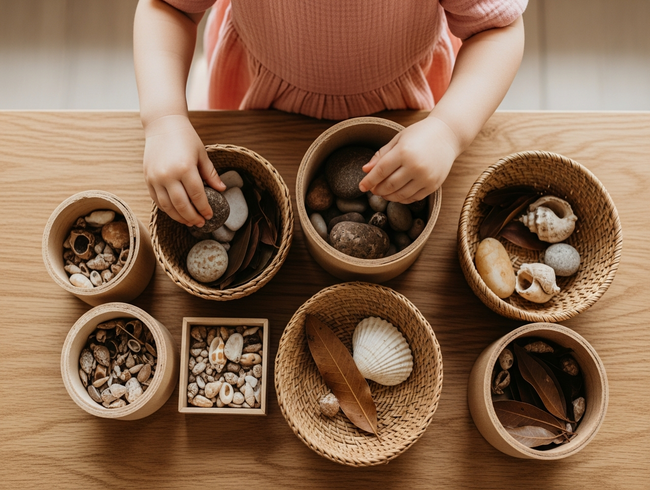
If your child loves filling and emptying containers (enclosure schema), offer different materials to explore the same concept: sand, water, small stones, dried pasta. If they’re fascinated by dropping things (trajectory schema), try different objects — a feather, a ball, a scarf — that fall in different ways. This supports the schema while naturally extending the learning.
When repetition becomes a concern: signs to watch for
Repetitive play is healthy and expected in toddlers. It’s worth seeking guidance from a paediatric occupational therapist or your GP if repetitive behaviours: cause significant distress when interrupted; seem disconnected from the environment or don’t involve objects or play; prevent the child from engaging in other activities or interacting with people; or appear very rigid and don’t change or develop over time. Context matters far more than frequency. Play that builds skills, adapts over time, and connects to the surrounding world is almost always healthy development in action.
Repetitive Play at Okinja Early Learning Centre
At Okinja, we understand that a toddler who repeatedly fills a bucket with sand, carries it across the yard, and tips it out isn’t being stubborn or stuck — they’re doing exactly what they need to do. Our educators are trained to recognise schema play in action and to support it with intention, rather than redirect it out of habit.
Our indoor and outdoor environments on the Sunshine Coast are designed with this in mind. Open-ended materials — natural objects, sand, water, loose parts, blocks — allow children to follow their schemas across different contexts. Ramps, containers, climbing structures, and sensory spaces all invite the kind of repeated exploration that builds deep understanding over time. Our approach is directly informed by the EYLF, and our educators plan environments and interactions that honour each child’s natural learning drive rather than work against it.

When you visit Okinja, you’ll see children who are allowed to go down the slide again, read the book again, and fill the bucket again — because our team knows that ‘again’ is where the real learning lives.
We invite you to see learning at Okinja in action. Book a tour and experience our approach for yourself.
Call us to arrange your visit and see how we support every child’s natural drive to learn