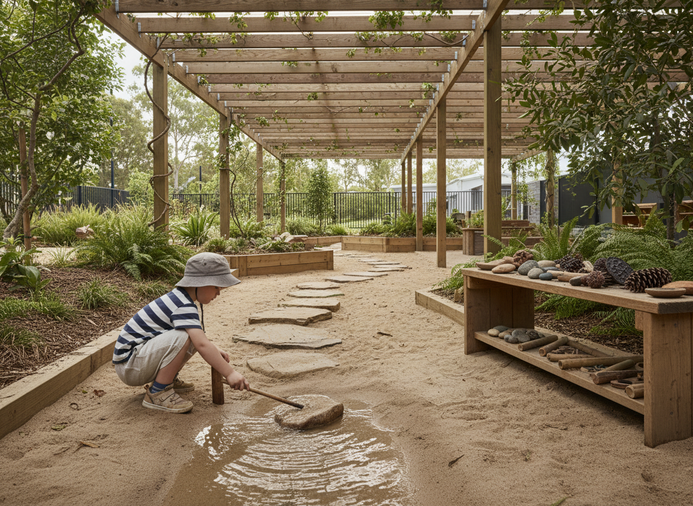
There is a moment that happens in almost every home and every early learning centre across Australia. A child picks up a stick, crouches beside a puddle, and begins to stir. They watch the water move. They poke the muddy edge. They drag the stick along the surface and study the ripple. To the adult watching, it might look like idle play.
To an early childhood educator, it looks like something far more significant.
That child is acting as a scientist. They are noticing, predicting, testing and wondering, the foundations of scientific inquiry, long before they have ever heard the word “science.” Understanding this changes everything about how we think about learning in the preschool years.
STEM stands for Science, Technology, Engineering and Mathematics, and it has become one of the most discussed topics in education. Parents browse online stores looking for “STEM toys.” Centres advertise “STEM programmes.” The word appears on posters, in brochures and across social media feeds. Yet decades of experience in early childhood education point in a different direction. The richest STEM learning for children aged three to six does not come packaged in a box. It emerges from the water trough, the sandpit, the kitchen sink and the garden bed. It comes from the materials in your recycling bin and the questions you ask while your child is already playing.
This article is for parents who want to understand what STEM actually means in the early years. It isn’t a branded curriculum or an expensive kit. It is a way of seeing the learning that is already happening, and knowing how to gently extend it.
Why the Early Years Are the STEM Years
Before we explore what everyday STEM looks like, it helps to understand why the preschool period is so important for laying STEM foundations.
The human brain undergoes its most rapid period of development in the first five years of life. During this window, neural connections form at a pace that will never be matched again. The experiences a child has during this time, from the textures they touch and the questions they ask to the problems they try to solve, help shape the architecture of their brain.
Children who build early confidence with spatial reasoning, mathematical thinking and scientific curiosity carry that foundation with them into school. Crucially, this development isn’t driven by formal instruction. It is driven by play.
Play is not the opposite of learning. For a child under six, play is the primary way learning happens. When a child fills and empties a bucket of water, they are building an intuitive understanding of volume. When they stack blocks and the tower falls, they are running a structural engineering experiment. When they plant a seed and check on it every day, they are making long-term scientific observations. The play is the curriculum.
The Four Pillars of Everyday Inquiry
A helpful way to understand how STEM shows up in children’s daily play is to think about four inquiry behaviours that sit underneath scientific and mathematical thinking. These aren’t steps in a formal process. They are natural patterns of thought, and children often cycle through all four within a single play session.
Noticing
Noticing is the first act of science. Before a child can investigate anything, they must observe it. Young children are extraordinary noticers when given the time and space to do so. They notice that the heavy metal spoon sinks while the plastic cup floats. They notice that the shadow of the tree changes position between morning and afternoon. They notice that some leaves crumble when dry but bend when wet. These observations are not trivial. They are the raw data from which all further thinking emerges.
At quality early learning centres, educators deliberately create environments that reward noticing. Magnifying glasses sit near the garden, collections of natural materials are displayed on low tables, and water troughs hold objects that behave differently in water. The environment itself becomes an invitation to look more closely.
Predicting
Once a child has noticed something, they almost immediately begin to form predictions, early theories about how the world works. “I think the rock will sink.” “I think the water will go all the way to the top.” “I think the ramp will make the car go faster.” These statements might seem like simple guesses, but they are the beginning of scientific reasoning. The child is drawing on what they already know, forming a theory and getting ready to test it.
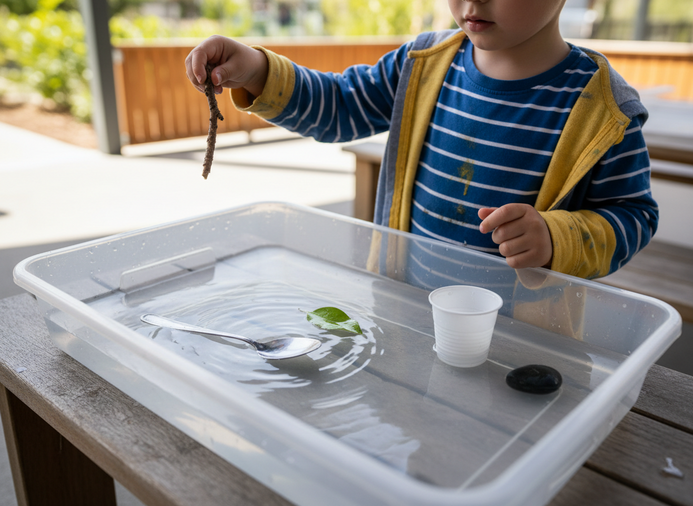
Adults can nurture this predictive thinking simply by pausing before an experiment and asking, “What do you think will happen?” That single question shifts the child from passive observer to active thinker.
Testing
Children do not need to be told to test their predictions. They do it instinctively. The child who predicted the rock would sink drops it in the water. The child who thought the ramp would make the car go faster tries it, then tries a steeper ramp, then a flatter one. This cycle of trying, observing, adjusting and trying again is the engineering design process in its purest, most natural form. It needs no instruction, only materials, time and the freedom to explore without an adult stepping in too early.
Wondering
The final pillar is perhaps the most important: wondering. The capacity to sit with an unexpected result and ask “why?” rather than moving on is what separates scientific thinkers from mere observers. Young children are natural wonderers, but this capacity can fade if adults rush to provide answers rather than holding space for the question. “That is such an interesting thing to wonder about. What do you think might be happening?” is a more powerful response than any correct explanation.
Everyday Materials, Extraordinary Learning
One of the most freeing realisations for parents is that the best materials for early STEM exploration aren’t expensive. They are already in your home and garden. Here is a brief look at what everyday materials offer.
Water
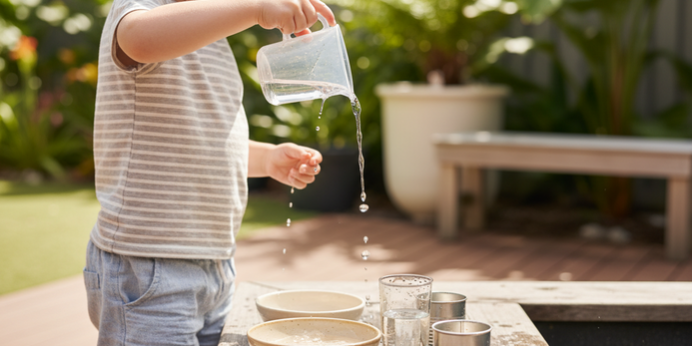
Water is arguably the single most valuable STEM material available to young children. It invites exploration of volume, capacity, flow, evaporation, surface tension, floating and sinking, and cause and effect. A water trough, or even a plastic tub in the backyard stocked with cups of different sizes, funnels, measuring jugs and a variety of objects, creates almost endless opportunities for inquiry. Questions like “How many small cups fill the big jug?” introduce early thinking about ratio and volume. “Why does the water go so much faster through the narrow tube?” opens conversations about pressure and flow.
Sand and Mud
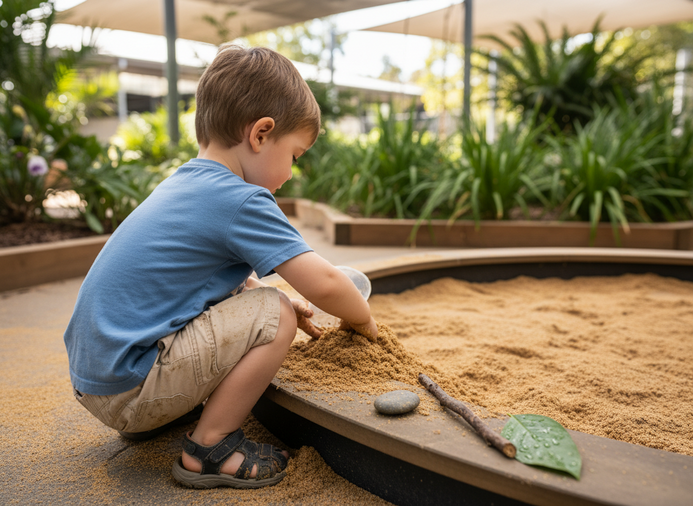
Sand and mud offer explorations of states of matter, structural engineering and material science. When a child adds water to dry sand and notices the change in consistency, they are observing a physical property change. When they try to build a wall that holds, they are working through a structural engineering challenge. When they discover that wet mud holds a shape but dry mud crumbles, they have met a fundamental principle of materials science. The sandpit is a laboratory.
Loose Natural Parts
Sticks, stones, leaves, shells, seed pods and pinecones are what early childhood educators call “loose parts.” These are open-ended materials with no fixed purpose, which children can combine, arrange, balance and repurpose freely. The more ways a material can be used, the more thinking it invites, and loose natural parts can be used in almost any way a child imagines. A collection of stones and sticks can become a counting exercise, a pattern-making activity, a balancing challenge or a building project, all within the same afternoon.
Kitchen and Household Materials
Measuring cups and spoons introduce mathematical concepts of quantity and equivalence. Mixing bicarbonate of soda and vinegar produces an exciting chemical reaction that introduces cause and effect. Freezing water, watching ice melt and seeing steam rise from a hot drink introduce states of matter. Ramps made from cardboard tubes and books introduce gravity and incline. Approached with curiosity, the home is as rich an environment for STEM exploration as any purpose-built learning space.
Equipping the Guide, Not Buying the Gear
The adult’s role in early STEM learning is one of the most misunderstood parts of this topic. It’s commonly assumed that supporting STEM learning means delivering lessons, demonstrating techniques or buying specialised equipment. In practice, the adult’s most powerful contribution lies in the language they use and the questions they ask, not in the materials they provide.
Three kinds of adult language are particularly valuable in STEM contexts.
“I Wonder” Language
Phrases like “I wonder what would happen if you added more water” or “I wonder why the big rock sank faster than the small one” model scientific curiosity without directing the child’s exploration. They signal that wondering is valuable in itself, and that not knowing is the beginning of finding out rather than a problem for an adult to solve.
Narration of Process
Simply describing what you see the child doing builds their STEM language and their awareness of their own thinking. “I can see you’re testing whether the flat stone floats. You tried it flat first, and now you’re turning it on its edge. You’re changing one thing at a time to see what happens.” This kind of narration names the scientific and engineering thinking that is already happening, making it visible to the child and giving them words to describe it.
Genuine Questions
Not all questions are equal. A question with a single correct answer, like “What colour is that?”, asks a child to recall rather than think. A genuinely open question, like “Why do you think the tower fell that time when it didn’t fall before?”, asks the child to reason, form a theory and explain their thinking. Asking genuine questions consistently is one of the most effective things any adult can do to support a young child’s STEM development.
The Environment as the Catalyst for Discovery
In the Reggio Emilia approach to early childhood education, there is an idea known as the “third teacher.” The first teacher is the family. The second is the educator. The third is the environment itself. A well-designed environment doesn’t just provide space for play. It provokes curiosity, creates challenges and extends thinking in ways no adult can sustain across an entire day.
What makes an environment a strong third teacher for STEM? A few qualities stand out.
Sensory richness is foundational. Environments that engage several senses at once, such as the texture of sand between fingers, the sound of flowing water, the smell of rain on dry earth or the contrast of light and shadow, give children more to notice and more to think about than environments that are visually bare or sensory-flat.
Natural variability matters just as much. Outdoor spaces with living plants, natural ground surfaces, weather, insects and the changing seasons offer a curriculum that never stands still. Unlike an indoor activity that stays the same each time, a garden presents something new every day. The same patch of ground looks different after rain, or after a hot, still week. Nature rewards children who look closely, and the more time they spend there, the more practice they get.
Open-endedness is the third critical quality. Environments stocked with materials that can be used in many ways, like loose parts, water, sand and tools for digging and building, generate far more thinking than rooms full of single-purpose toys with one correct use. The child with a pile of sticks and a bucket of water faces endless possibility. The child with a branded “STEM kit” faces a set of instructions.
These ideas sit at the heart of how we work at Okinja Early Learning Centre. Our curriculum is play-based and draws on natural elements, play theory and Reggio-inspired practices, delivered through an emergent approach that follows what each child is genuinely curious about. Our indoor and outdoor learning environments are designed to invite discovery, conversation, collaboration and connections to nature, and our educators use pedagogy to provoke children’s thoughts, questions and emerging interests rather than hand them answers. We also build environmental awareness through the sustainable practices we use every day, which gives children plenty of real-world science to notice and wonder about.
This commitment to the environment as an educator is also reflected in Quality Area 3 of the National Quality Standard, which recognises the physical environment as a key part of quality early childhood education.
Mathematics Is Hiding in Plain Sight
When most parents think of STEM, they think of science first: experiments, discoveries, the dramatic fizz of a chemical reaction. But mathematics is just as present in children’s everyday play, and it’s worth making it visible.
Early mathematical thinking isn’t about numbers and equations. It is about pattern, spatial reasoning, quantity, comparison and relationships, and these ideas are woven through play in ways that feel completely natural to young children.
Pattern recognition is one of the earliest and most fundamental mathematical skills. Children who arrange shells in a repeating sequence, sort buttons by colour and size, or notice that the floor tiles make a repeating shape are identifying and extending patterns. This capacity later supports algebraic thinking, music, coding and working with data.
Spatial reasoning is the ability to picture shapes in your mind and understand how objects relate to one another in space, and it is closely linked to later mathematics learning. Block play, puzzles, building with natural materials and even drawing all develop it. Parents can support it easily, too. Using everyday spatial words like “above,” “below,” “behind,” “rotate” and “flip” during play gives children the language they need to think and talk about space.
Measurement emerges whenever a child compares objects. This stick is longer than that one. This container holds more than that one. I’m taller than you but shorter than Dad. These informal comparisons are the foundation for all the formal measurement skills that come later.
A Note on Screen-Based “STEM” Content
It would be incomplete to discuss early STEM learning without mentioning the growing range of screen-based content marketed as STEM education for young children. Apps, videos and interactive games often claim to build coding skills, mathematical thinking or scientific understanding.
The picture for children under six is nuanced. Some well-designed interactive apps can support specific skills, particularly when an engaged adult sits alongside the child and talks about the content. Passive viewing, however, offers very little genuine STEM learning. The key difference between screen-based content and hands-on play is physical cause and effect. When a child pours water, they feel its weight, hear its sound, see its surface and get wet. They receive immediate feedback through every sense. No screen replicates that, and it is exactly this feedback that drives the deep learning we have described throughout this article.
This isn’t an argument against all screen use. It is an argument for making sure that hands-on, real-world exploration remains the main way preschoolers experience STEM.
What to Look for in a Quality Early Learning Environment
For parents choosing an early learning centre, or simply wanting to know what quality STEM provision looks like, here are a few things worth observing.
Look at the learning environments, indoors and out. Are they rich with natural and open-ended materials? Are there opportunities for children to dig, build, pour, observe and explore? Is there evidence of ongoing projects, such as a garden being tended or a construction left out to continue tomorrow, rather than only activities that are set up and packed away? A quality environment often looks purposeful and slightly “in progress,” a sign that inquiry is alive and ongoing.
Listen to the language educators use. Are they asking genuine open-ended questions, or steering children toward predetermined answers? Do they use “I wonder” language? Do they describe children’s thinking in a way that makes the learning visible? The quality of educator language is one of the most reliable signs of the quality of learning in any early childhood setting.
Observe the pace of the day. Children need long, uninterrupted stretches of time for the deep exploratory play that drives STEM learning. A programme that moves children through short activities every fifteen to twenty minutes doesn’t give inquiry time to develop. Look for programmes that protect long periods of child-led play.
Look for documentation of learning. Quality early learning centres observe, record and reflect on children’s thinking and share it with families. Learning stories, journals and documented observations that capture the process of a child’s inquiry, not just the finished product, show a philosophy that values thinking as well as outcomes.
Beginning at Home: A Practical Starting Point
If you’re feeling inspired to create more STEM-rich moments at home, the starting point is simpler than you might expect.
You don’t need to buy anything. You need to slow down and pay attention. The next time your child is truly playing, not performing for you or following your instructions, watch what they are doing through the lens of this article. Are they noticing? Predicting? Testing? Wondering? Almost certainly, they are doing all four. Your role isn’t to improve the activity with a better toy. It’s to be genuinely curious alongside them.
Ask one genuine question. Wait for the answer. Follow their thinking wherever it leads. Resist the urge to correct, redirect or explain. Trust that the child crouched beside the puddle, stirring with a stick, is doing something deeply important, and that your quiet, curious presence beside them is one of the most powerful ways you can support their learning.
The Bigger Picture: Raising Curious, Capable Thinkers
The goal of early STEM education isn’t to produce child scientists or future engineers, although some of these children will grow up to be exactly that. The goal is to protect and nurture curiosity, the instinct that asks “why?”, “what if?” and “I wonder what happens when…”
Curiosity isn’t taught. It is either nurtured or worn down by the environments we create and the language we use around young children. Every time an adult meets a child’s question with genuine curiosity instead of a quick answer, makes space for a child to test their own theory instead of supplying the correct one, or treats a child’s play as serious and meaningful learning, they strengthen the disposition that sits underneath all scientific, mathematical and technological thinking.
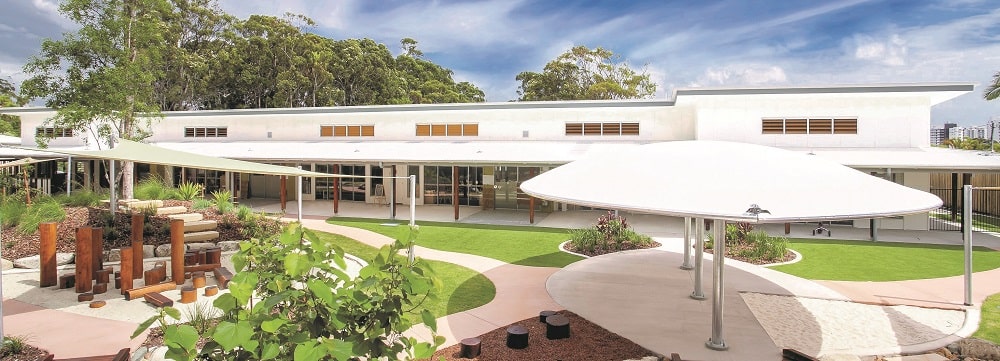
At Okinja, we believe every child is unique, with their own thoughts and questions, and that children should be encouraged to follow their own inquisitive nature. Our program follows the Early Years Learning Framework, with its focus on being, belonging and becoming, and everyday STEM play touches all three. Children are fully present in the moment of discovery, they build a sense of belonging as they investigate and solve problems together, and they become capable, confident learners who trust their own ideas.
The preschool years aren’t preparation for the “real” learning that happens at school. They are some of the most important learning years of a child’s life, and they deserve rich, intentional, play-based environments. The puddle and the stick are enough. The curious child and the curious adult beside them are everything.
At Okinja Early Learning Centre on the Sunshine Coast, our environments and our educators are grounded in decades of early childhood education experience and designed around exactly this kind of everyday discovery. If you would like to see what play-based STEM learning looks like in practice, book a tour and come and see for yourself.