Your toddler spots the tallest climbing frame at the park and makes a beeline for it, arms pumping, absolute determination written across their face. Your heart does that familiar little lurch, and before you even think about it, the words are already out, “Be careful!”
It is one of the most universal parenting reflexes in existence. But here is a thought worth sitting with: what if that instinct, as loving and well-intentioned as it is, is actually working against your child’s development? What if the very experiences that make your stomach drop a little, the climbing, the jumping, the scrambling up things that are just slightly too high, are precisely the experiences your toddler’s brain and body are wired to seek out?
This is not about being a reckless parent or running a reckless early learning centre. This is about understanding the difference between a hazard and a risk, and recognising that one of the most important things we can do for toddlers is give them the space to encounter, evaluate, and navigate manageable physical challenges. On the Sunshine Coast, and in quality early learning environments everywhere, this philosophy has a name: risky play.
The Crucial Distinction: Hazard Versus Risk
Before we go any further, it is worth drawing a very clear line between two words that are often used interchangeably but mean very different things in the world of early childhood development.
A hazard is a danger that is hidden, unpredictable, or beyond a child’s capacity to evaluate. A broken rung on a ladder. A rusty nail hidden under mulch. A climbing frame with no softfall beneath it. These are things a child cannot see, assess, or make a meaningful decision about. Removing hazards is non-negotiable, and it is the absolute foundation of everything we do.
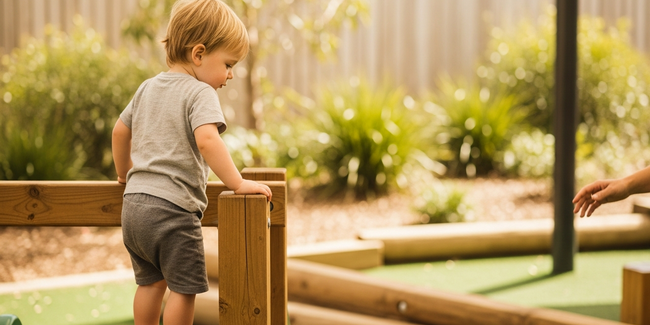
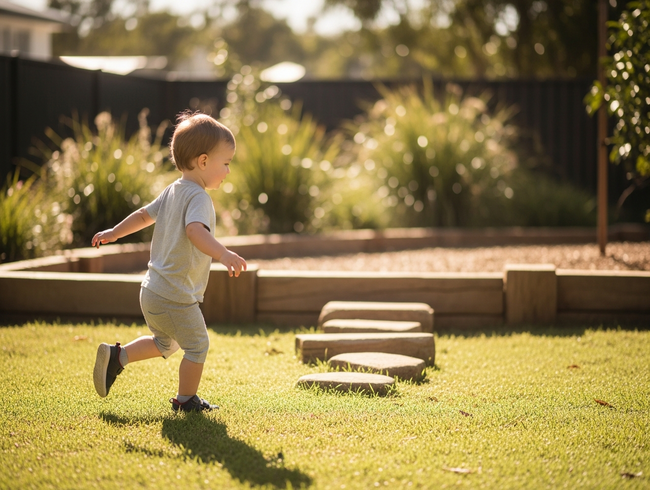
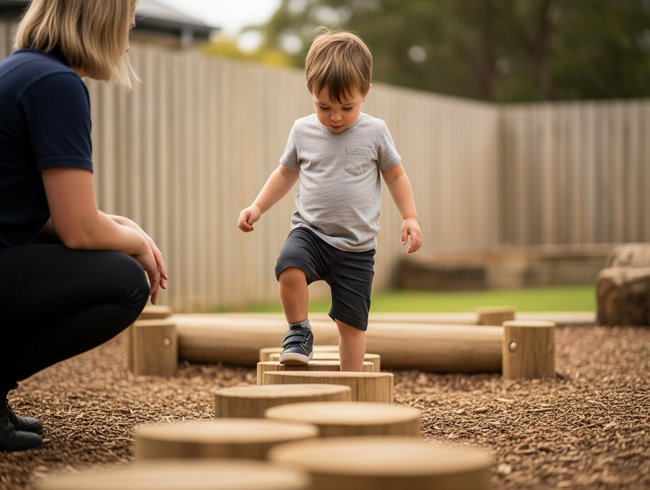
A risk, on the other hand, is a visible, measurable challenge that a child can see, think about, and choose to engage with. The slightly wobbly stepping stone. The low timber beam that requires balance. The climbing frame that is a little higher than what they have tried before. These are experiences that carry a possibility of a minor stumble or a scraped knee , and that is actually the point.
When children encounter risk in this sense, something remarkable happens. They slow down. They look. They think. They test one foot, then the other. They make a decision. In that single sequence of events, they are building risk-assessment skills, physical confidence, spatial awareness, and a fundamental understanding of their own capabilities.
The research supporting this is not fringe or controversial. Play researchers have identified six distinct categories of risky play that children across cultures consistently seek out: play with heights, play with speed, play with dangerous tools, play near dangerous elements, rough-and-tumble play, and play where children can disappear or get lost. These are not aberrations. They are patterns that show up again and again in how young children choose to play.
Why Toddlers Need to Climb, Jump, and Test Boundaries
There is a reason toddlers are relentlessly, exhaustingly, magnificently physical. Their brains are in the middle of an extraordinary period of development, and movement is not a distraction from that development. It is the development.
Every time a toddler navigates an uneven surface, their brain is building what researchers call proprioception , the body’s internal sense of where it is in space. Every time they climb and feel the pull of gravity against their muscles, they are developing core strength, coordination, and the vestibular system that will underpin everything from sitting still in a classroom to riding a bike a few years from now.
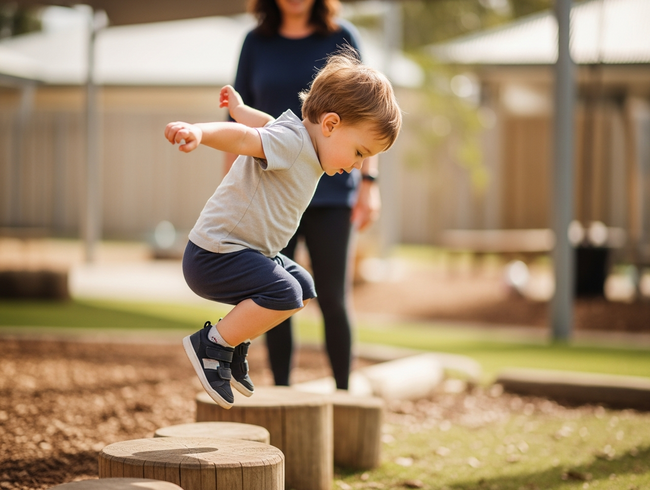
This is sometimes called physical literacy , the intuitive, embodied understanding of how your body moves through the world. Like reading literacy, it is built through repeated, varied, and increasingly challenging experience. You cannot develop physical literacy by watching from the sidelines. You build it by doing: by jumping from a stump and feeling your knees absorb the landing, by shifting your weight on a wobbly log and catching yourself before you fall, by hauling yourself up one more rung and discovering that you are stronger than you thought.
There is also an important emotional dimension to this. When a toddler attempts something that genuinely challenges them , not something handed to them, but something they worked for , and they succeed, they experience a very specific kind of joy. It is the joy of competence: I tried something hard, and I did it. This is where self-efficacy , a person’s belief in their own ability to achieve things , first takes root.
Children who are chronically over-protected from physical risk, research suggests, often develop heightened anxiety. When every challenge is removed before they can encounter it, they never get the opportunity to discover that they can handle things.
The Language Shift: What to Say Instead of “Be Careful”
So if “be careful” is not the ideal response, what do we say instead? This is a question worth spending some real time on, because the language we use around physical challenge shapes children’s inner voice for years to come.
The problem with “be careful” is that it is essentially meaningless. It does not give a child any useful information. It signals anxiety without offering guidance, and if used reflexively and constantly, it can communicate a quiet but powerful message: I do not think you can handle this.
Here are some alternatives that educators trained in risky play philosophy use, and that parents can begin practising at home:
- “What is your plan for getting down?” This hands the problem back to the child. It says: I trust you to think about this.
- “How does that feel? Does it feel safe to you?” This builds interoceptive awareness , the ability to check in with their own body’s signals.
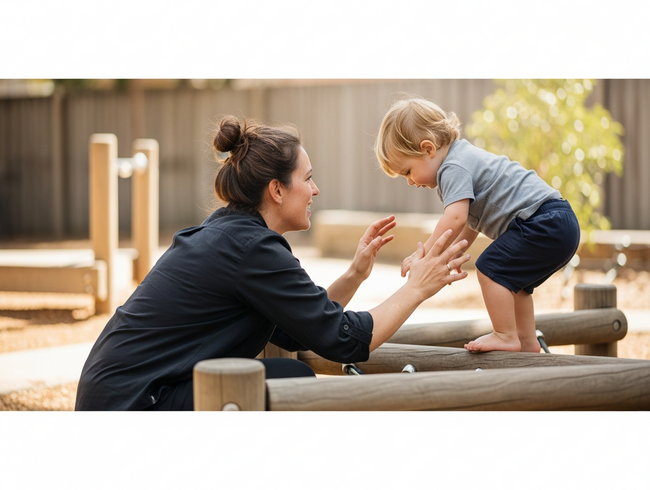
- “I am right here if you need a steady hand.” This offers presence without intervention. It communicates: I am your safety net, not your removal service.
- “What can you hold onto to help you balance?” This is a thinking prompt rather than a rescue. You are not doing it for them; you are helping them work it out.
- “You did it! How did you figure that out?” This shifts the focus from the outcome to the process, building metacognitive skills alongside physical ones.
None of this means ignoring genuine danger. If a child is about to do something that presents a real hazard , something they cannot assess and that carries serious risk of significant injury, you intervene, clearly and calmly. The skill is in telling the difference, and in letting the manageable challenges be theirs to navigate.
How Quality Early Learning Environments Design for Risky Play
Risky play does not happen by accident in a quality early learning environment. It is designed for, deliberately and thoughtfully, with meticulous attention to the line between hazard and risk.
At Okinja, this sits inside a play-based curriculum that draws on natural elements, play theory and Reggio-inspired practices, delivered through an emergent approach that follows what each child is genuinely curious about in the moment. Our educators use pedagogy to actively provoke children’s thoughts, discussions, questions and ideas rather than directing how a challenge should be approached, which means a child’s own emerging sense of what they are capable of stays at the centre of the experience.
In practice, this looks like outdoor environments with natural elements that carry inherent, manageable challenge: uneven terrain, low climbing structures, stepping stones of varying heights, balance beams, loose natural materials that can be stacked and shifted. It means softfall surfaces beneath climbing elements, and educators trained not just in safety compliance but in the developmental reasoning behind physical challenge, so they know when to watch, when to offer a prompt, and when to step in.
It also means a culture of documentation and reflection. In risky play environments, educators observe and record how individual children are engaging with physical challenge over time. They notice which children consistently avoid the climbing frame and gently explore why. They celebrate the child who, after weeks of watching, finally decides today is the day.
Risky Play Through Being, Belonging and Becoming
Our program follows the Early Years Learning Framework, with its focus on being, belonging and becoming, and risky play is a good example of how those three ideas show up in a single afternoon outdoors.
- Being is the toddler on the wobbly log right now, fully absorbed in the immediate, embodied task of staying upright. There is no future goal in that moment, just the present-tense work of feeling their weight shift and adjusting for it.
- Belonging is the educator standing close, steady and unhurried, and the quiet trust that grows from a child knowing an adult is present without taking the challenge away from them. It is also the child’s growing connection to the outdoor environment itself, the same climbing frame, the same patch of uneven ground, returned to again and again until it feels like theirs.
- Becoming is what accumulates underneath all of it: the physical literacy, the risk assessment skills, the growing belief that I can figure hard things out. A toddler does not become a confident, capable mover in a single afternoon. It happens gradually, one wobbly log and one climbing frame at a time, and it is exactly the kind of learning the EYLF asks early childhood educators to notice, support and extend.

A Note for Parents: Your Anxiety Is Valid, and Here Is What to Do With It
If reading this has brought up some discomfort, that is completely understandable. The instinct to protect our children is one of the most powerful forces in human experience. It has kept our species alive. It is not something to be dismissed or overridden with a few statistics.
But here is what the research, and the day-to-day experience of educators who work with young children, consistently shows: the goal is not to eliminate your protective instinct. The goal is to calibrate it, to learn to tell the difference between situations that genuinely require intervention and the many situations where the most loving thing you can do is take a slow breath, stay close, and let your child discover what they are capable of.
Your toddler is not trying to scare you when they dash for the climbing frame. They are doing exactly what they are supposed to do. They are seeking the challenge their developing brain and body need. They are being, in the most fundamental sense, a child.
At Okinja Early Learning Centre on the Sunshine Coast, our outdoor environments and our educators are grounded in decades of early childhood education experience and designed around exactly this philosophy. If you would like to see what risky play looks like in practice, and what it means for the children in our care, book a tour and come and see for yourself.