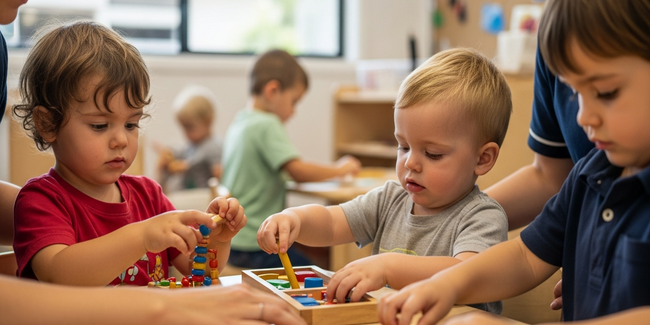
Every parent has watched it happen: a toddler completely absorbed in stacking blocks, only to have the tower tumble down, and instead of giving up, they start again. What looks like simple play is actually something extraordinary. That moment of persistence, problem-solving, and emotional regulation is executive function in action, and it’s being built right before your eyes.
These are the mental skills that help children plan, focus, remember instructions, and juggle multiple tasks at once. And the good news? The best way to build them isn’t through worksheets or drills. It’s through play.
What Exactly Is Executive Function, and Why Does It Matter In Early Childhood?
Executive function is an umbrella term for a set of cognitive skills managed by the brain’s prefrontal cortex. Think of it as the brain’s air traffic control system. For young children, these skills don’t arrive fully formed. They are constructed, slowly and carefully, through the experiences children have in their earliest years. There are three core components: working memory, which allows children to hold and use information in their mind; cognitive flexibility, which helps them adapt to new situations or change their thinking; and inhibitory control, which enables them to pause before acting and resist distractions.
Research consistently shows that children with strong executive function skills perform better in school, have healthier relationships, manage stress more effectively, and are better equipped to make sound decisions as they grow into adults. These are not innate, fixed traits. They are skills that develop significantly between the ages of two and seven, making early childhood the most critical window for cultivation.
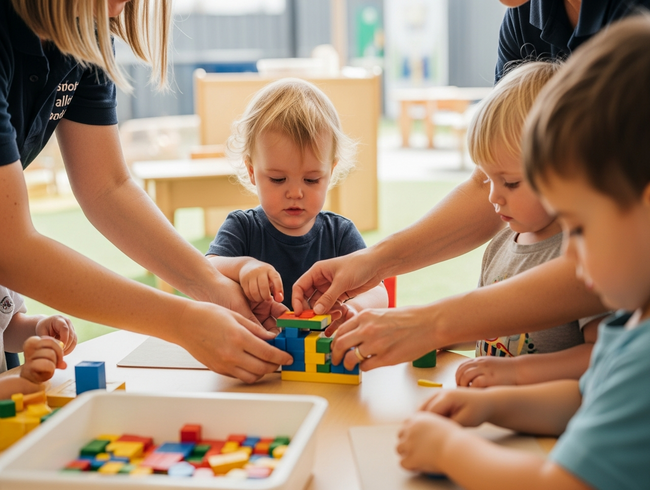
How Play Builds the Brain’s Control Centre
When children engage in authentic play, not structured, adult-directed activities, but genuinely self-initiated exploration, they are constantly exercising their executive function muscles. Consider what happens during a single episode of imaginative play in a home corner. A child decides the rules of the game (planning and cognitive flexibility), remembers who has what role (working memory), waits their turn to speak (inhibitory control), and adjusts when a friend changes the storyline (adaptability). Every element of the play is a workout for the developing brain.
Neuroscientists and early childhood researchers have found that complex, imaginative play, especially play that is child-led, activates the prefrontal cortex more reliably than direct instruction. When children engage in pretend play, they must hold a mental representation of their role, follow self-imposed rules, regulate their emotions and impulses, and respond flexibly to their peers. This is the cognitive equivalent of a full-body workout.
Open-ended materials are particularly powerful catalysts. Loose parts such as natural materials, fabric, containers, and wooden pieces don’t come with instructions. Children must imagine their purpose, experiment with possibilities, and persist when their first idea doesn’t work. This kind of unscripted problem-solving is precisely what builds the neural architecture of executive function in ways that no worksheet or app can replicate.
How Natural Environments Support Executive Function
The Sunshine Coast is uniquely placed to offer children some of the richest play-based learning environments in Australia. The natural world of beaches, hinterland bushland, open parks, and gardens provides the kind of open-ended, unpredictable settings that challenge children’s thinking in ways no manufactured toy ever could. Outdoor environments naturally scaffold executive function by presenting problems that don’t have a single answer.
High-quality early learning centres leverage this environment intentionally. Rather than confining children to indoor classrooms with structured lessons, the best centres integrate indoor and outdoor spaces fluidly, allowing children to direct their own exploration while skilled educators observe, extend, and gently challenge their thinking. This is the model backed by decades of research, and it looks very different from rote learning.
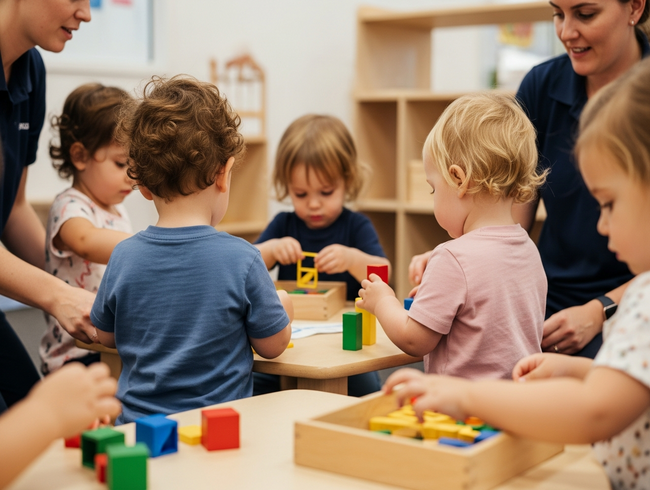
Practical Play Activities That Build Executive Function In Early Childhood
Parents often ask: “What can I do at home to support my child’s development?” The answer is simpler than most expect. Here are some play-based activities that specifically target executive function skills.
Dramatic and pretend play is one of the most powerful tools available. When children assign roles, create storylines, and maintain characters over time, they are exercising working memory and inhibitory control in a deeply engaging way. Encourage your child to set up a “shop,” a “hospital,” or a “restaurant,” and resist the urge to take over the narrative.
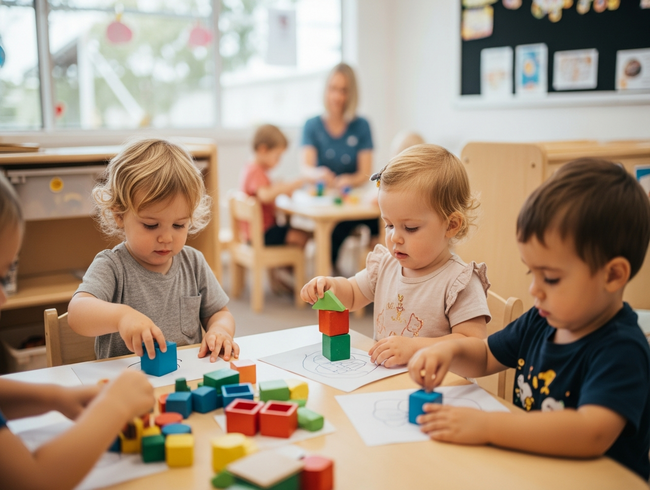
Building and construction activities, whether with blocks, recycled materials, or mud and sticks in the backyard, require planning, problem-solving, and the ability to hold a goal in mind while working through setbacks. These activities build cognitive flexibility as children test ideas and revise their approach.
Movement and music games such as “Simon Says,” “freeze dance,” or clapping rhythms demand inhibitory control and working memory simultaneously. They’re also joyful, and joy is a powerful enhancer of learning and memory consolidation.
Nature-based play offers endless opportunities. Sorting shells on the beach, following a trail through bushland, or tending to a garden bed all present children with real-world challenges that require planning, attention, and flexibility, without a single worksheet in sight.
Knowing When to Step In, and When to Step Back
One of the most nuanced aspects of supporting executive function development is knowing when to step in and when to step back. The instinct to help, to solve the problem, to smooth the conflict, to redirect the frustration, is natural and loving. But it can inadvertently rob children of the very experiences that build their capacity for self-regulation and independent thinking.
Skilled early childhood educators understand this distinction deeply. They observe before intervening. They ask questions rather than providing answers. They might introduce a new material that extends the challenge, or gently narrate what they notice (“I can see you’re trying really hard to make that balance”) without taking over the direction of the play. This approach, sometimes called “serve and return” interaction, honours children’s agency while providing the warm scaffolding that supports growth.
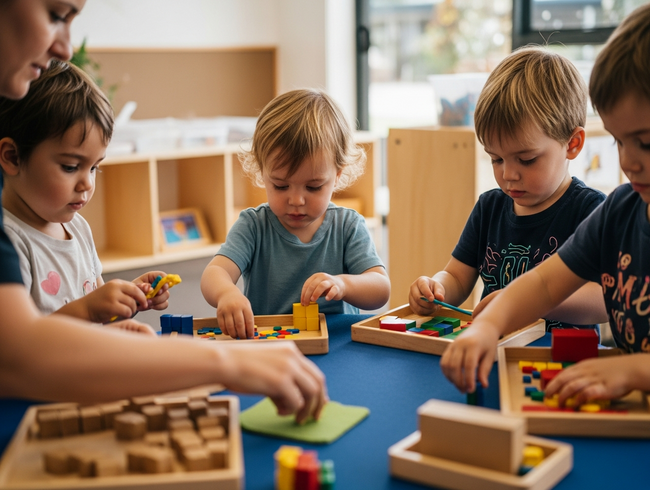
Language plays an enormous role here too. When educators and parents use rich, descriptive language during play, naming emotions, articulating processes, wondering aloud, they are simultaneously building vocabulary and providing children with the verbal tools to manage their own internal states. “I notice you felt frustrated when that didn’t work. What do you think you could try next?” is a question that supports both emotional regulation and problem-solving at once.
Recognising Executive Function Growth At Home and In Care
One of the gifts of understanding executive function is that it transforms how we see children’s behaviour. The child who seems to be “just playing” with water and cups is developing working memory and cause-effect reasoning. The child in the midst of a meltdown because the routine changed is showing us that their inhibitory control and cognitive flexibility are still very much under construction. This isn’t failure; it’s neurologically appropriate development in progress.
The partnership between home and the early learning centre is crucial, and parents can support executive function development at home in beautifully ordinary ways. Here are some simple principles families can apply.
Reduce screen time in favour of unstructured play. The research is clear: passive screen consumption does not build executive function. In contrast, open-ended play, even when it appears chaotic or unproductive, is doing serious developmental work.
Embrace boredom. When children say “I’m bored,” resist the impulse to immediately fill the gap. Boredom is the precursor to creativity. It requires children to draw on their own internal resources, to plan, imagine, and initiate. These are executive function skills.
Use routines and predictability. Consistent daily routines reduce the cognitive load on children, freeing up mental energy for learning and exploration. Simple visual schedules, regular meal and sleep times, and predictable transitions all support working memory and emotional regulation. Everyday household tasks fit naturally into this rhythm too: setting the table, sorting laundry, or helping to cook all require planning, sequencing, and working memory.
Play alongside your child. You don’t need to direct the play. Simply follow your child’s lead and be present. Board and card games build turn-taking and impulse control in a joyful context, and giving children genuine choices within safe boundaries builds the experience of agency and decision-making that underpins executive function. Above all, your attentive, engaged presence is itself a powerful support for their development.
When home and early learning environments work in harmony, using shared language, consistent expectations, and a mutual commitment to child-led exploration, the developmental benefits compound. Children experience coherence between their two primary worlds, and that coherence itself is deeply supportive of self-regulation and emotional security.
A Note on Academics and School Readiness
A common concern among parents is whether a play-based approach will leave children “behind” academically. The evidence suggests the opposite is true. Children who enter primary school with strong executive function skills, built through rich play-based early learning, consistently outperform peers who received early academic instruction over time. The advantage compounds: children who can pay attention, regulate their emotions, hold information in working memory, and think flexibly are better positioned to learn everything from reading to mathematics to social studies.
School readiness, properly understood, is not about knowing the alphabet or counting to twenty. It is about having the cognitive and social-emotional tools to engage with a learning environment. Play builds those tools more effectively than any other approach available to us.
Choosing an Early Learning Environment That Truly Supports Your Child
At Okinja Early Learning Centre, executive function isn’t a separate lesson on a timetable. It is woven through the way the day unfolds. Our play-based curriculum draws on natural elements, play theory, and Reggio-inspired practices using an emergent approach, which means learning follows the genuine interests and questions of the children rather than a fixed script. When a child’s curiosity leads the way, the planning, focus, and flexible thinking that make up executive function are being exercised constantly and naturally.
This is where the balance between child-led and educator-guided play matters. Our educators use pedagogy to provoke children’s thoughts, discussions, questions, and ideas. They know when to step back and let exploration run, and when to introduce a provocation that gently stretches a child’s thinking. It’s a deliberate, research-backed practice, grounded in decades of early childhood experience and guided by the Early Years Learning Framework, with its focus on being, belonging and becoming. The result is an environment where children build focus, memory, and self-control without ever realising they’re “working.”

When you visit a centre and see children absorbed in complex, joyful play, with educators engaging thoughtfully with their thinking rather than directing it, you’re watching executive function development in action. Executive function is not a gift some children are born with and others aren’t. It is a capacity that grows in the right conditions. And those conditions, above all else, look like play.
We’d love to show you what that looks like for your child. Book a tour of Okinja and see our learning environments, and the thinking they nurture, in action.