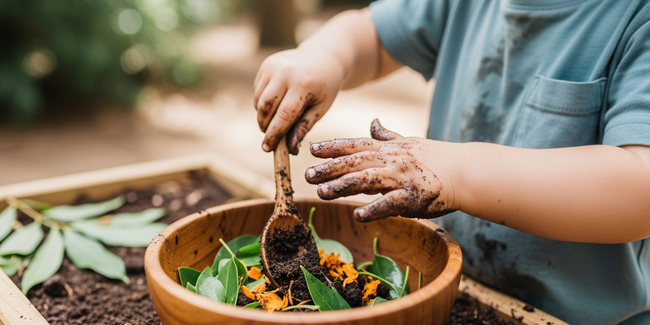
Is that mud-smeared smile just about having fun, or is your toddler in the middle of a profound scientific experiment? When you see fingers covered in paint or hear the joyful splash of water, do you see a mess to be cleaned, or a mind being built? As parents, we often find ourselves caught between the instinct to keep things tidy and the undeniable delight our children find in getting gloriously, unapologetically messy.
At Okinja Early Learning Centre & Kindergarten, our decades of experience in early childhood education have taught us to see this “mess” through a different lens. We see it not as chaos, but as one of the most powerful and essential forms of learning for a developing mind. It’s the hands-on, sensory-rich work of childhood, where the foundations for science, literacy, and emotional resilience are laid, one squish, splash, and smear at a time.
This guide is our invitation to you, the families of the Sunshine Coast, to look past the cleanup and into the incredible developmental science of messy play. We want to empower you by revealing the deep learning hidden within these activities and provide practical, confidence-boosting play based learning activities for toddlers to help you welcome this vital exploration into your life.
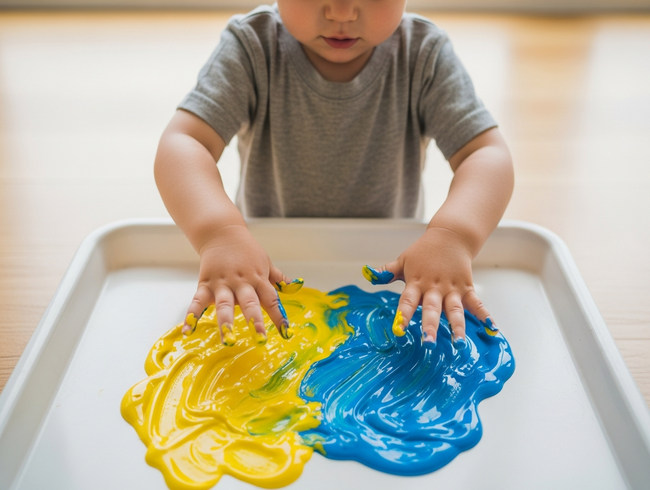
Beyond the Mess: Deconstructing the Power of Sensory Play
Before a child can understand abstract concepts like letters or numbers, they must first understand the world through their senses. Messy play is a direct, unfiltered dialogue between a child and their physical environment. When a toddler plunges their hands into a bowl of cool, smooth finger paint or feels the gritty texture of wet sand, they are doing far more than making a mess—they are sending a flood of information to their brain.
Think of a young child’s developing brain as a garden. Each new sensory experience—the smell of damp earth, the sound of water pouring, the feeling of playdough squishing between their fingers—is like a seed being planted. The repeated engagement with these materials nurtures these seeds, helping them sprout into complex neural pathways. These connections form the very architecture of the brain, creating a robust foundation for all future learning.
This approach is at the core of the nation’s Early Years Learning Framework (EYLF), which guides our practice. Messy play is a perfect expression of its principles of “Belonging, Being, and Becoming.”
- Being: It allows children to be completely present and absorbed in the moment, exploring without pressure or expectation.
- Belonging: It connects them to their physical world, giving them agency to manipulate and understand their environment.
- Becoming: Through these explorations, they become confident, creative, and capable learners, building an identity as someone who can experiment and solve problems.
High-quality early learning, as defined by the National Quality Standard (NQS), prioritises educational programs that are child-led and rich in open-ended experiences. Messy play is not just an activity we offer; it’s a fundamental part of a program that respects a child’s innate curiosity as the primary driver of their development.
The Learning Lab: How Mess Unlocks a Toddler’s Potential
So, what exactly is happening when your toddler is covered head-to-toe in mud? They are attending a masterclass in holistic development. Let’s break down the curriculum of the messy play “learning lab.”
1. The Budding Scientist (Cognitive & Scientific Skills)
Messy play is a child’s first physics and chemistry lab. It is a world of pure cause and effect, where every action yields an immediate and fascinating result.
- The Science: When a child pours water into dry sand, they witness a transformation. They learn that adding more water makes it sloppier, and less water makes it firm enough to build. This isn’t just play; it’s an investigation into properties, consistency, and volume. They are forming hypotheses and testing them in real-time.
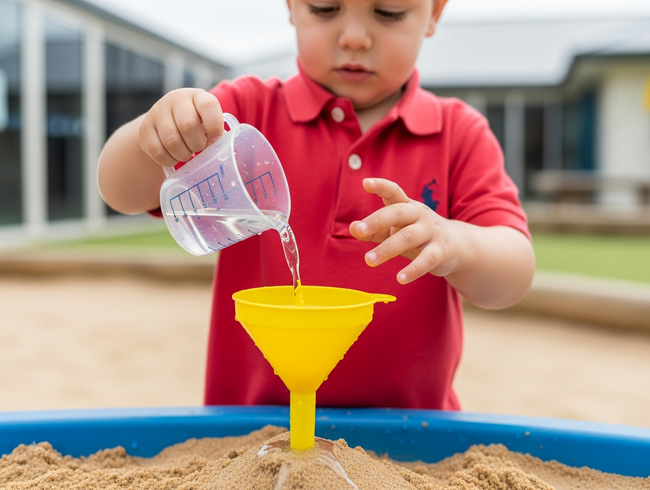
- How to Explore at Home: A simple “mud kitchen” in the backyard with old pots, pans, and utensils becomes a laboratory for potion-making. Water play with cups, funnels, and jugs allows for endless experiments in gravity and measurement. Even mixing cornflour and water creates a magical non-Newtonian fluid (oobleck) that challenges their understanding of solids and liquids.
2. The Confident Communicator (Language & Literacy)
The rich sensory feedback from messy play provides a powerful catalyst for language development. It gives children tangible experiences that they need words to describe.
- The Language: How do you explain “slimy,” “gritty,” “sticky,” or “cold” to a child who has never truly felt them? Messy play builds a library of descriptive words grounded in real experience. As educators or parents, we can support this by verbalising what we see: “I see you’re squishing that cold, wet clay,” or asking, “How does that feel on your fingers?”
- How to Explore at Home: Finger painting with non-toxic, taste-safe paints (like yogurt with food colouring) encourages children to talk about the colours and shapes they are making. Hiding plastic letters in a tray of shaving cream or sand for them to find is a fun, tactile way to introduce early literacy concepts.
3. The Little Mathematician (Numeracy & Logic)
Mathematical concepts can be incredibly abstract. Messy play makes them concrete and understandable.
- The Maths: Pouring, scooping, and filling are the foundational actions of understanding volume, capacity, and measurement. A child trying to fill a bucket with sand one scoop at a time is intuitively learning about quantity and one-to-one correspondence. They explore concepts like “full,” “empty,” “more than,” and “less than” in the most practical way imaginable.
- How to Explore at Home: Provide various containers during water or sand play and encourage your child to see how many small cups it takes to fill one big bucket. Counting bubbles as they pop them in the bath or sorting coloured pom-poms from a tray of soap foam are joyful ways to engage with early numeracy.
4. The Skilled Mover (Fine & Gross Motor Development)
The simple act of playing with messy materials is a fantastic workout for a child’s developing muscles.
- The Movement: Squeezing a sponge, pinching and rolling playdough, and picking up slippery pieces of cooked pasta all strengthen the small muscles in the hands and fingers. These fine motor skills are the same ones they will later need to hold a pencil, use scissors, and button a coat. At the same time, carrying buckets of water, stomping in mud, or making large-scale paintings on the ground develops gross motor skills, enhancing their balance, coordination, and strength.
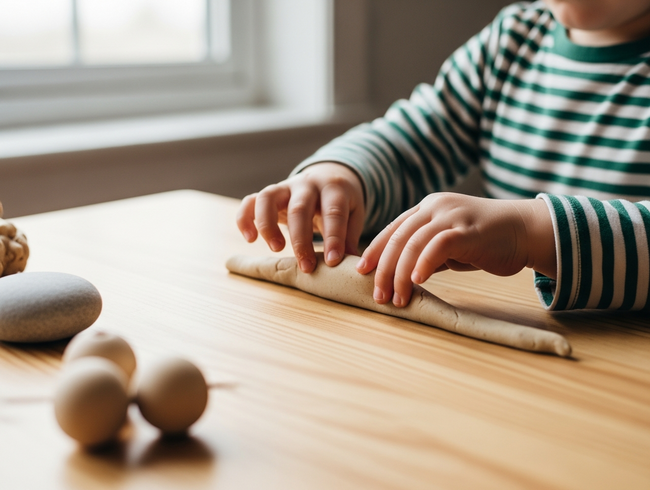
- How to Explore at Home: Simply providing a tray of playdough with some child-safe tools is a perfect fine-motor workout. For gross motor fun, a supervised “puddle jumping” session on a rainy day or painting the fence with a large brush and a bucket of water are wonderful options.
5. The Resilient Friend (Social-Emotional Growth)
Perhaps the most overlooked benefit of messy play is its profound impact on a child’s emotional wellbeing.
- The Emotion: In messy play, there is no right or wrong way to do it. There is no finished product to strive for. This freedom from expectation lowers anxiety and allows a child to simply be. It builds confidence and self-esteem by giving them complete control over their actions. The sensory input itself can be incredibly calming and regulating for children who feel overwhelmed or anxious.
- How to Explore at Home: Set up a large piece of paper on the floor for a collaborative family finger-painting session. Sharing a sandpit or a sensory bin teaches children about negotiation, sharing space, and respecting others’ creations. The calming effect of simply running hands through a tray of dry rice or sand can be a wonderful tool for helping a child self-regulate after a busy day.
The Practical Guide: Making Messy Play Manageable and Joyful
We understand the primary barrier for parents is the cleanup. But with a little preparation, messy play can become a stress-free and cherished part of your routine.
- Set the Stage for Success: Designate a “yes” space where messes are okay. This could be an old sheet or tarp on the kitchen floor, the bathtub (a brilliant, contained space!), or a specific spot in the backyard.
- Embrace the Right Ingredients: You don’t need expensive art supplies. The best materials are often in your pantry. Cornflour and water, cooked spaghetti, shaving cream, soap foam, sand, mud, and water are all fantastic, low-cost options.
- Make Cleanup Part of the Play: The learning doesn’t stop when the activity is over. Frame the cleanup as the next step of the game. Provide your child with a small bucket of soapy water and a cloth to “wash” their tools and the play area. This builds a sense of responsibility and introduces practical life skills.
- Your Role as the Learning Guide: Your role isn’t to direct the play, but to create a safe and inviting environment for it. Sit nearby, observe, and show interest. Ask open-ended questions that encourage thinking, like, “I wonder what will happen if we add another scoop?” or “Tell me about what you’re creating.” Your calm, engaged presence gives them the security to explore freely.
At Okinja, Nature is the Ultimate Sensory Bin
At Okinja Early Learning Centre & Kindergarten, our philosophy is grounded in the belief that the richest learning materials are not bought in a store; they are provided by the world around us. This principle is the heart of our play-based curriculum and is woven into the very design of our centre.
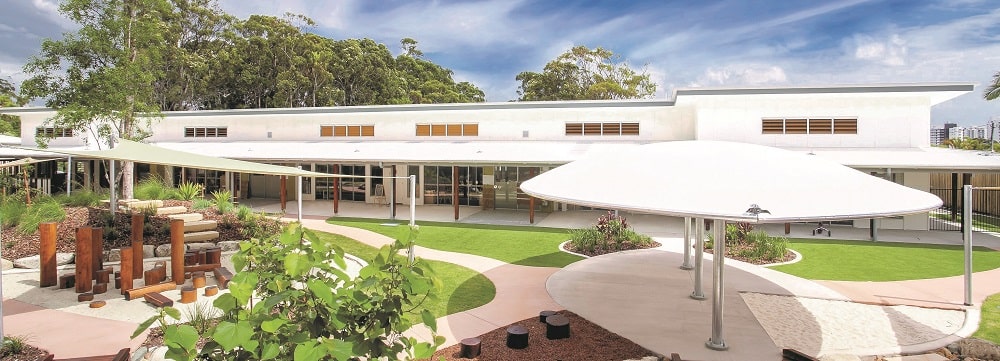
Our unique position on the Sunshine Coast, nestled near the Alex Forest Bushland Park and the ocean, is not just a beautiful backdrop—it’s an essential, active part of our learning environment. Our four separate, purpose-built playgrounds become extensions of this natural classroom. Here, sand, soil, water, leaves, and twigs are the tools for discovery. This constant connection to nature provides an ever-changing canvas for authentic, child-led messy play, grounding children’s learning in the sensory richness of our local environment.
This is how we live our commitment to “Belonging, Being, and Becoming”—by ensuring children feel a deep and meaningful connection to their community, their world, and their own incredible capacity for discovery.
Embrace the Joy of Discovery
The next time your child comes to you with muddy hands and a beaming smile, we hope you see more than just a future bath time. We hope you see a scientist testing a theory, an artist exploring a new medium, and a confident child building a strong and capable brain.
By embracing the mess, you are not just cleaning up spills; you are validating your child’s curiosity, honouring their innate drive to learn, and giving them the freedom to develop in the most joyful and profound way possible.
The best way to understand the power of our play-based philosophy is to see the joy and deep learning it sparks in person. We invite you to book a tour of Okinja Early Learning Centre & Kindergarten to see how our expert educators intentionally design experiences that turn a child’s natural curiosity into a foundation for lifelong learning. You’ll see how our thoughtful indoor spaces and enriching outdoor areas work together to support this powerful approach. Contact Okinja ELC on 07 5479 2222 to arrange your visit.